Menù
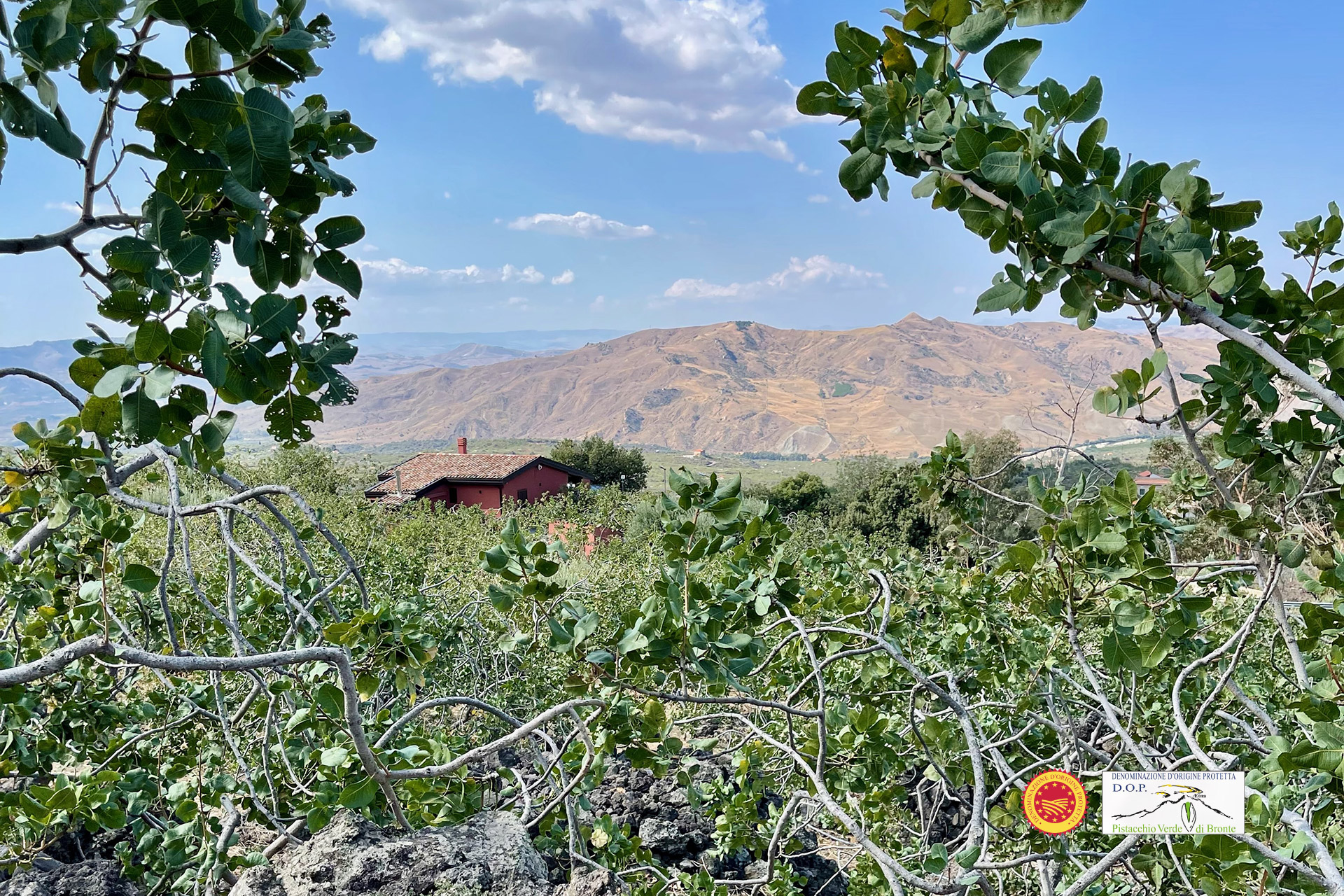
For about ten years now, pistachios have been on everyone’s lips. They’ve become the star ingredient in snacks, spreads, and ice cream, even surpassing hazelnuts in terms of consumption—including as an ice cream flavor.
Many factors have contributed to this success, including various social media trends—one of which is the “Dubai chocolate” trend, featuring kataifi pastry and, of course, pistachios.
But we want to focus specifically on Bronte pistachios and how to recognize this particular variety.
In Bronte, in fact, pistachios are not a fad—nor are they a passing trend—but rather an integral part of the local culinary heritage.
Native to Syria, the pistachio was introduced to Greece following the conquests of Alexander the Great, then reached Italy via the Romans between 20 and 30 A.D., and finally spread to Sicily during the Arab rule, between the 8th and 9th centuries A.D. Here, the pistachio found a particularly favorable environment, with volcanic soil rich in minerals and a climate very similar to that of its native land—characterized by significant temperature fluctuations between day and night and fairly high average annual rainfall.
But if there are different types of pistachios, how can we tell which one is the real Bronte pistachio?
There are certain features that, with a little care, can easily be recognized with the naked eye and assure us of the product's authenticity.
First of all, the shape of the pistachio “kernel”: slender and elongated, very different from the more commonly known shape of the typical snack pistachio, which is short and stubby.
Then there’s the color: purplish on the outside and emerald green on the inside—a far cry, then, from any shade of yellow found in other types of pistachios.
On a deeper level—that is, when tasted—the flavor of the Bronte pistachio is also uniquely distinctive and intense. In fact, it needs neither to be salted nor roasted, precisely because it is already “rich” by nature. This richness stems precisely from the lava soil (the “sciara”) on which the pistachio trees in Bronte take root and grow.
And once the product is packaged and released for sale? How can we recognize an authentic package of Bronte Pistachio DOP?
First of all, let's say that the real Bronte pistachio is protected by DOP , or Protected Designation of Origin. Specifically, the correct name is “ Pistacchio Verde di Bronte ”, a name registered in the European Union with Regulation (EC) no. 21 of 12 January 2010.
From a purely technical standpoint, the protected designation of origin "Pistacchio Verde di Bronte" is reserved for the unshelled, shelled, or peeled product of the botanical species " Pistacia vera ," cultivar "Napoletana" (also known as "Bianca" or "Nostrale"), grafted onto " Pistacia terebinthus ." The latter, the Terebinth, is essentially the wild tree, abundant in some areas of Sicily, onto which the fruit-bearing plant, the one that will actually produce pistachios, is grafted. Without Terebinth, the Bronte Pistachio could not exist, because it is precisely the robustness and strength of the Terebinth (also known as "scornabecco" or "spaccasassi") that allows the plant to penetrate the lava rocks and absorb all the necessary nutrients from the soil.
From a more commercial standpoint, however, there are specific regulations governing the sale of Bronte pistachios, ensuring that consumers receive an authentic product.
However, we must first distinguish between two scenarios: one in which you wish to purchase Bronte Pistachios as they are—that is, natural and whole—and another in which you wish to purchase a product made “WITH” Bronte Pistachios.
In the first case, in fact, we are dealing with a product that has actually received PDO certification—that is, the “Bronte Green Pistachio PDO” par excellence. And only in this case will you find the EU Protected Designation of Origin (PDO) symbol on the product packaging—that is, the well-known round yellow-and-red label— along with the protected designation’s logo, which depicts Mount Etna, the pistachio, and the inscription “Pistacchio Verde di Bronte” below.
In the second case, however, it is strictly prohibited to use either the EU symbol or the protected designation logo for the product’s labeling, presentation, or advertising.
But what exactly is meant by a product made with Bronte pistachios? It refers to any product ranging from chopped pistachios onward—in other words, essentially any product that is not a whole Bronte pistachio (in the shell, shelled, or peeled).
Therefore, in the case of composite, processed, or transformed products that contain “Pistacchio Verde di Bronte” in a percentage less than 100%, the correct label wording to look for is “Pistacchio Verde di Bronte DOP.”
For products made exclusively from “Pistacchio Verde di Bronte DOP,” such as chopped pistachios or pure pistachio paste, the label must include the statement “100% Pistacchio Verde di Bronte DOP.”
Furthermore, the guidelines regarding the font size to be used on labels and packaging for products made with Bronte pistachios are also very specific.
Finally, in the case of a processed product made with Bronte pistachios in a percentage less than 100%, the “Bronte Green Pistachio PDO” ingredient must be the sole component within its respective product category. Therefore, for example, there cannot be a pistachio cream made with 30% pistachios, where 20% are Bronte Pistachios PDO and 10% are pistachios from another origin.
There are two different organizations responsible for safeguarding and ensuring that all regulations concerning Bronte Pistachios are properly applied and observed.
With regard to the whole product, the competent body is the“Consorzio di Ricerca Filiera Carni - CoRFilCarni GCC,”based in Messina at the Department of Veterinary Sciences of the University of Messina, Annunziata Campus. Since its establishment, CoRFilCarni has pursued the specific institutional goal of achieving and guaranteeing the highest levels of production and quality in agri-food products, while promoting traceability throughout the entire production cycle. The mission of the consortium and the professionals working within it is to provide detailed solutions and services to a diverse clientele—ranging from producers to consumers—who are increasingly attentive to a culture of sustainable and transparent development.
As for all other products derived from or made with Bronte pistachios, the relevant authority is the Consortium for the Protection of “Pistacchio Verde di Bronte DOP, ” located in Bronte at Piazza N. Azzia 14.
The purpose of the consortium is to raise awareness and promote the “Pistacchio Verde di Bronte” and its quality characteristics in Italy and abroad through targeted promotional and informational activities.
In particular, one of the main objectives that the Protection Consortium has been pursuing over the years is to step up inspections of the “Pistacchio Verde di Bronte” PDO product, in order to combat fraud and, at the same time, ensure the product’s traceability.
In 2026, Sciara finalized its membership in both consortia, thereby offering its customers all the quality and assurance of a 100% authentic product that is inspected and meets the highest quality standards in production.
In fact, the Sciara product line includes both pure Bronte pistachios and products made from them, such as creams, pestos, chopped pistachios, and pure Bronte Pistachio PDO paste.
For more information on this topic, please contact our team at commerciale@sciarapistacchio.com or by phone at 095 692643.